




As clinicians working with trauma survivors, we’ve all encountered that moment when a client describes feeling “stuck,” when traditional evidence-based treatments plateau, or when the weight of post-traumatic stress disorder (PTSD) or complex trauma seems immovable despite our best therapeutic efforts. After twenty-three years of clinical practice, including specialized work with complex developmental trauma and PTSD, I’ve come to understand that healing from trauma requires more than technique—it demands a fundamental shift in how we hold space for suffering.
At Empathy Grove, we’ve integrated the best ketamine-assisted therapy (KAT) in Portland, Oregon into our trauma treatment model, not as a replacement for established modalities, but as a catalyst that can accelerate and deepen the healing process. What distinguishes our approach is the intentional centering of empathy, both as a neurobiological target and as a therapeutic stance. Here’s what we’ve learned about how empathy-based ketamine therapy can transform trauma recovery.
Understanding the Neurobiology of Trauma and Empathy
To appreciate how ketamine therapy works for trauma, we must first understand what happens in the traumatized brain. PTSD fundamentally alters neural circuitry, particularly affecting three key regions:
- The Amygdala (hyperactivated, constantly scanning for threat)
- The Hippocampus (impaired, struggling to contextualize memories)
- The Prefrontal Cortex (underactive, reducing emotional regulation capacity)
This triad creates the classic PTSD symptom constellation: hypervigilance, intrusive memories, emotional dysregulation, and avoidance. Traditional treatments like Prolonged Exposure (PE) and Cognitive Processing Therapy (CPT) work by gradually reconsolidating traumatic memories through repeated, controlled exposure. These approaches are effective, the research is clear, but they’re also demanding, with dropout rates ranging from 20-50% according to a comprehensive meta-analysis published in the Journal of Traumatic Stress.
Enter ketamine’s unique mechanism. Unlike traditional antidepressants that modulate serotonin or norepinephrine over weeks, ketamine acts rapidly on the glutamate system, specifically as an NMDA receptor antagonist. This triggers a cascade of neuroplastic changes:
- Rapid synaptogenesis in the prefrontal cortex
- Increased BDNF (Brain-Derived Neurotrophic Factor) production
- Reduced default mode network (DMN) activity, which correlates with decreased rumination
- Enhanced connectivity between brain regions that have become isolated by trauma
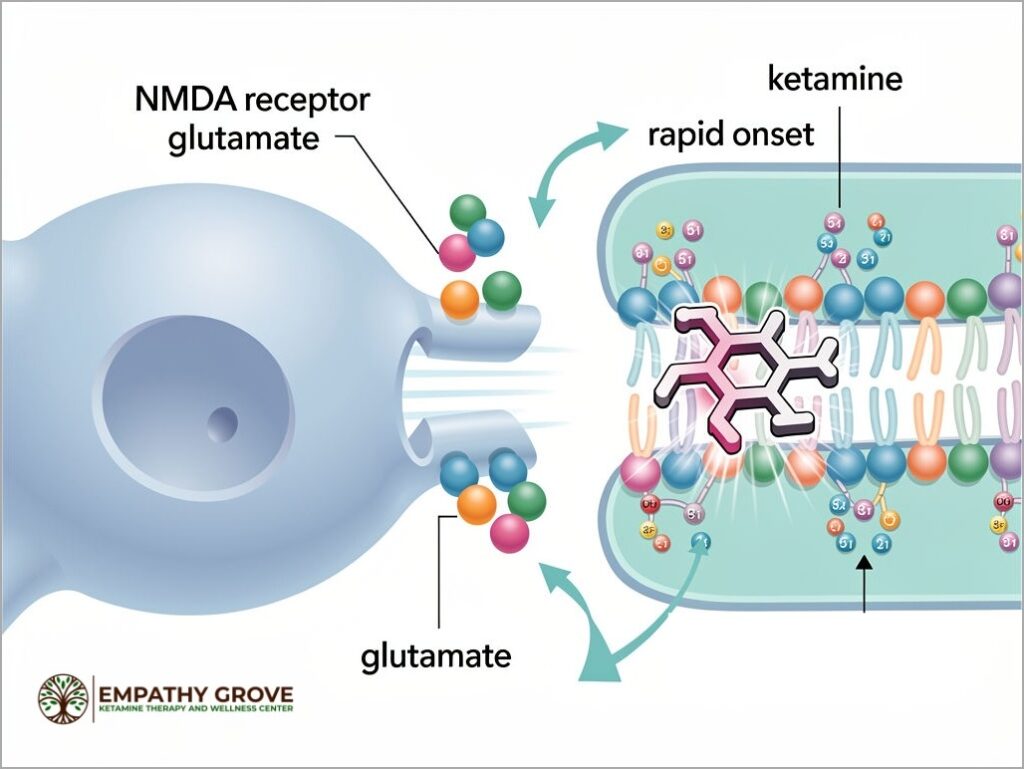
Research from Yale University’s Department of Psychiatry found that ketamine can restore synaptic connections in as little as 24 hours, connections that typically take weeks to rebuild with conventional treatments.
But here’s what makes this particularly relevant for trauma: ketamine also appears to facilitate fear memory reconsolidation while simultaneously enhancing self-compassion and relational connection, the empathic capacities often most damaged by trauma.
The Empathy Deficit in Trauma
Trauma doesn’t just create symptoms; it fundamentally disrupts our capacity for self-empathy and connection with others. Survivors often describe feeling:
- Emotionally numb or disconnected from themselves and loved ones
- Shame-bound, viewing themselves through the lens of their trauma
- Hypervigilant in relationships, unable to trust or be vulnerable
- Isolated, even when surrounded by support
This empathy deficit is both a symptom and a maintaining factor of PTSD. Neuroscience research shows that chronic stress and trauma actually reduce gray matter volume in brain regions associated with empathy and social cognition.
Traditional trauma therapies address this indirectly through the therapeutic relationship, but ketamine offers something unique: a direct neurobiological pathway to temporarily dissolve the rigid defensive structures that keep survivors isolated from themselves and others.
Empathy-Based Ketamine Therapy: A Clinical Model
At Empathy Grove, we’ve developed a protocol that intentionally leverages ketamine’s empathogenic properties, its capacity to enhance feelings of connection, self-compassion, and perspective-taking. Our model consists of five integrated components:
1. Trauma-Informed Preparation
Healing begins with the therapeutic relationship. Before any medicine session, we establish safety, trust, and a collaborative alliance that supports deep trauma work and nervous system regulation. Preparation includes:
- Comprehensive trauma history and symptom assessment
- Psychoeducation about trauma neurobiology and ketamine’s mechanism
- Establishing intentions and identifying “stuck points” in recovery
- Teaching grounding and self-regulation skills
- Medical screening to ensure safety
Throughout this process, ketamine is framed not as a standalone solution, but as a tool that can create a temporary window of neuroplasticity and emotional openness, a window we intentionally work with together.
2. The Medicine Session: Holding Empathic Space
Our ketamine sessions occur in a carefully designed environment:
- Soft lighting, comfortable recliners, weighted blankets
- Curated music designed to facilitate emotional processing
- A trained therapist present throughout, offering empathic attunement without intrusion
The therapist’s role is not to direct or interpret, but to witness with compassion. We’ve found that this empathic presence—simply being held in non-judgmental awareness—is itself therapeutic for trauma survivors who’ve often felt profoundly alone in their suffering.
During the dissociative state, clients frequently report experiences of:
- Viewing their trauma from a new perspective (“I could see it wasn’t my fault”)
- Feeling compassion for their younger, traumatized self
- Experiencing a sense of connection or “oneness” that counters isolation
- Accessing emotions that have been defended against for years
3. Immediate Integration (Same Day)
As the ketamine effects subside, we spend 30-45 minutes helping clients begin to articulate and ground their experience. Questions we explore:
- What did you notice or discover?
- Were there moments of insight or shift in perspective?
- What emotions arose? What was it like to feel them?
- How might this experience inform your healing journey?
This immediate processing is crucial. Research on memory reconsolidation suggests there’s a critical window (approximately 6 hours) when memories are most malleable after being activated.
4. Structured Integration Therapy (Weekly for 6-12 weeks)
This is where the real work happens. Ketamine creates the opening; integration therapy builds the new structure. We typically combine:
- Internal Family Systems (IFS): Helping clients develop compassionate relationships with traumatized “parts” of themselves
- Somatic therapy: Processing trauma held in the body, now more accessible due to reduced defensive dissociation
- Compassion-focused therapy: Deliberately cultivating self-empathy and self-soothing capacities
- Intuitive Healing Sessions: A transpersonal, mind-body-spirit approach that may include gentle bodywork, somatic therapy, soul reclamation, and energetic clearing to support deep healing, trauma integration, and restoration of wholeness.
5. Community and Connection
Recognizing that healing happens in relationship, we offer:
- Trauma-informed support groups
- Partner/family psychoeducation sessions
- Peer integration circles where clients can share experiences
Practical Considerations for Clinicians
If you’re considering incorporating ketamine into your trauma practice, here are key considerations:
1. Training and Competence
- Ensure proper medical training or partnership with physicians experienced in ketamine administration
- Pursue specialized training in psychedelic-assisted therapy (organizations like MAPS offer excellent programs)
- Maintain trauma-informed care principles throughout
2. Client Selection
- Best suited for treatment-resistant PTSD or complex trauma
- Requires medical screening (cardiovascular health, psychosis history)
- Client must have sufficient ego strength and support system
- Contraindicated for active substance use disorders (though past history isn’t necessarily exclusionary)
3. Setting Matters
- Create a trauma-sensitive environment (control over lighting, temperature, privacy)
- Ensure clients feel safe and in control (ability to stop treatment if needed)
- Have crisis protocols in place for difficult experiences
4. Integration is Non-Negotiable
- Ketamine without integration is incomplete treatment
- Plan for at least 6-8 integration sessions post-medicine work
- Coordinate with existing treatment providers when appropriate
5. Manage Expectations
- Ketamine is a tool, not a cure
- Some clients have profound experiences; others have subtle shifts. Both can be therapeutic
- Emphasize that healing is a process, not an event
Ethical Considerations and Limitations
As enthusiastic as I am about this modality, we must acknowledge limitations and proceed with humility:
Access and Equity: At $400-800 per session, ketamine therapy remains largely inaccessible to many trauma survivors. At Empathy Grove we offer payment plans, advocate for insurance coverage, and partner with the Thank You Life organization to help eliminate the financial barriers to psychedelic-assisted therapy for those who need it to find mental health freedom.
Research Gaps: While promising, large-scale RCTs specifically examining ketamine for PTSD are still limited. The VA/DoD is currently conducting trials, but we need more data, particularly on long-term outcomes and optimal protocols.
Potential for Harm: In the wrong hands, without proper screening, medical oversight, or integration support, ketamine can be ineffective or even harmful. The proliferation of “ketamine clinics” offering treatment without therapeutic support concerns me deeply.
Cultural Considerations: The dissociative experience ketamine produces may be interpreted differently across cultures. We must remain culturally humble and avoid imposing Western psychological frameworks on diverse experiences.
The Future of Ketamine-Assisted Trauma Treatment
I believe we’re at an inflection point in trauma treatment. For too long, we’ve asked survivors to do the heroic work of healing with one hand tied behind their backs, working against neurobiological changes that make healing extraordinarily difficult. Ketamine, used thoughtfully within an empathy-centered, trauma-informed framework, can untie that hand.
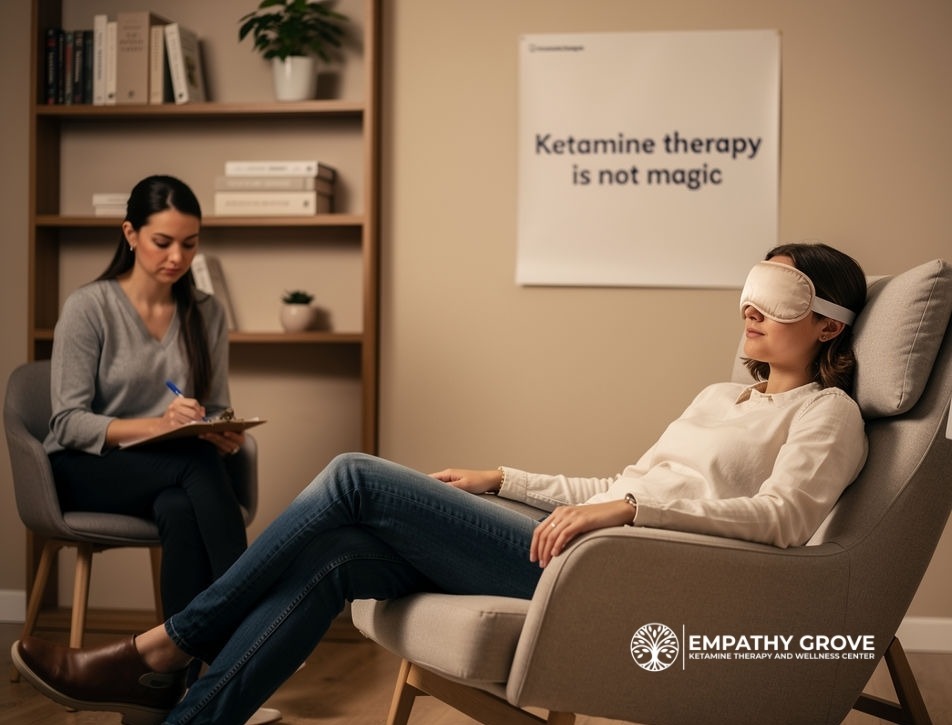
But let’s be clear: ketamine therapy is not magic.
The magic is in the relationship, the empathic holding, the skilled integration, the courage of survivors to face their pain, and the gradual rebuilding of connection to self and others. Ketamine simply helps us do this work more efficiently and, often, more humanely.
As clinicians, our task is to remain both open to innovation and grounded in ethical practice. To be excited about new tools while maintaining scientific rigor. To honor both the neuroscience, and the profound human experience of healing.
For those of us privileged to walk alongside trauma survivors in their recovery, empathy-based ketamine therapy offers a powerful addition to our clinical toolkit, one that can help our clients not just survive their trauma, but reclaim their capacity for connection, meaning, and joy.
Dr. Amy Kelchner, ND, is the Clinical Director of Empathy Grove Ketamine Therapy and Wellness Center in Portland, Oregon, where she specializes in trauma treatment and ketamine-assisted therapy.